The extraordinary lives
of ordinary Amsterdammers
Read the stories in english
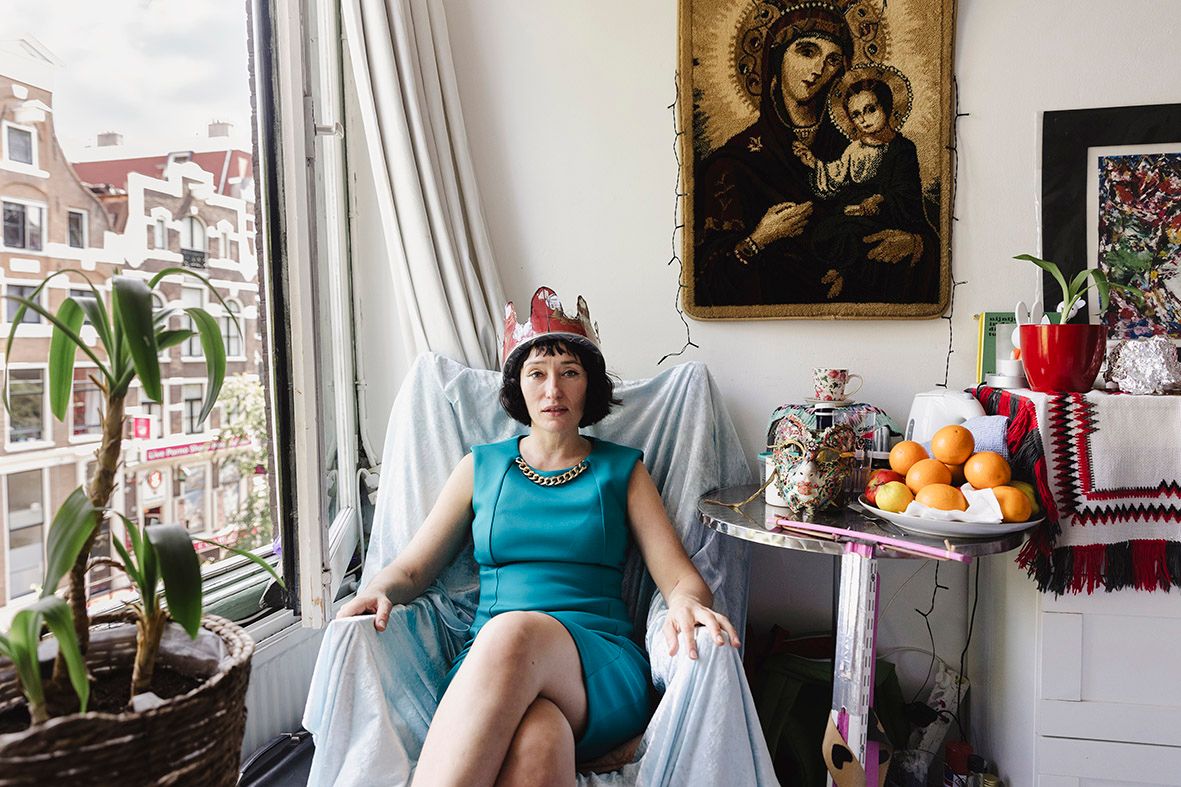
Kristina
Kristina has “infiltrated the devil’s asshole.” She says it with conviction, eyes lit, as if it were both a battle cry and a punchline. “This neighborhood,” she adds, waving a cigarette under the smug gaze of Casa Rosso’s pink elephant, “is the devil’s asshole. And I’m in it. But I’m changing it from the inside.”
The window of her room opens onto the chaos of De Wallen, but inside her room, everything is ritual: a Miffy altar with burning tea lights, tangled beads and broken pearls, a tapestry of Mary and child stitched above a collection of rose quartz hearts and plastic gemstones. She wears turquoise, barefoot on a mandala cloth, and lifts a sequined mask over her face. It’s hard to tell if it’s a performance or an invocation.
She tells the stories of how she worked at the UN, on disarmament, studied terrorism in California, crossed checkpoints in Ramallah, and almost got shot because she flinched. She was born in the USSR but sent to Israel at twelve with a group of Children of Chernobyl, so her parents could escape to the US. “They couldn’t leave unless one of us stayed behind... I was the sacrifice.”
KRISTINA grew up without her parents, from boarding school, to foster homes. She learned Hebrew by listening, Arabic by proximity. For the major part of her teenage years she was undocumented, invisible.
Quick to learn, sharp-eyed, creative and endlessly resourceful, she carries herself like a warrior who’s had to tame her past: that part of her that can’t trust safety, can’t sit still inside a mold. She fled every stable opportunity like it was a trap, and rejected a life of corporate comfort, catapulting instead towards the first moment that made her feel truly seen : winning the first prize at an art competition in De Oude Kerk.
“It was like coming out, like people finally saw my soul." .
In Amsterdam, she tried to live normally — whatever that means for a woman who’s been a refugee, a negotiator, a witness and an artist. But life takes unexpected turns and accidents happen, like when a metal door cracked her skull open on the sidewalk of Oudezijds Voorburgwal. “I should be dead,” she says, not dramatically, but with the fatigue of someone who’s had to say it too often.
Instead, she returned to the site of the accident for a rebirth art event.
Kristina doesn’t pretend to be an artist; she is art. Over the past 15 years, she has managed to fuse her life experiences and raw creative energy into a new persona: the Queen of Arts, through which she’s launched a crusade against corporations and Pop Art, “because it’s soulless, commercial, fake.”
In her Kingdom of Magical Red Lights, she’s taken Cupido hostage with his own gun, which Banksy dropped on her doorstep on Valentine’s day, for people to “stop having meaningless sex and fall in love again.”
It takes a special soul to follow Kristina’s story. It requires gift and effort to see through the chaos of her prayer stones, plastic bunny lamp, rose-shaped porcelain, bullet-pink lipstick and crowns. But the prize is a vision of limitless creativity and uncompromising activism. A peek into a life you wouldn’t believe, until you saw the scars it left on her.
Read the stories in english
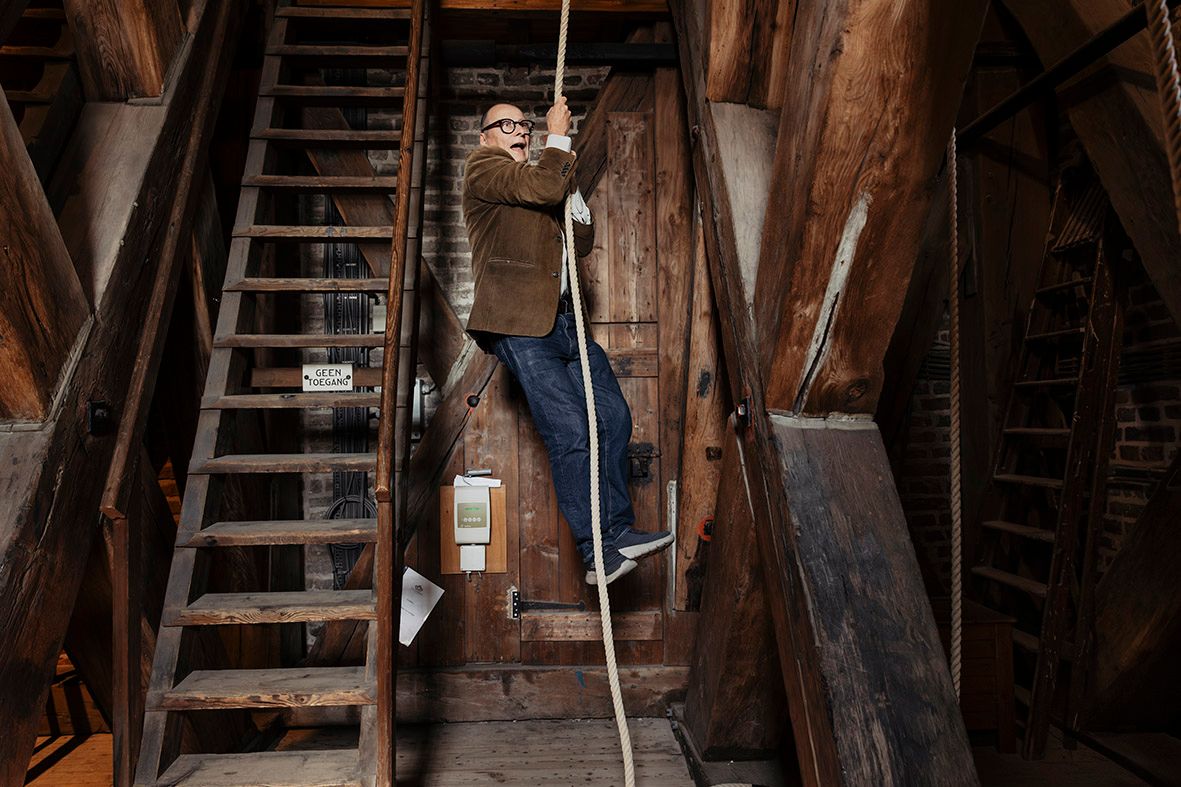
BERT
Bert’s doorbell is hard to find. People see the church, towering old and silent, and assume no one actually lives in the old adjacent buildings. But BERT does.
Inside, the stairs are cramped, with cracks running along the plaster like a map of quiet history. Photographs of friends lost and marriages celebrated long ago hang softly along the walls. There's an old bande dessinée of Astérix tucked on a shelf, a subtle clue to Bert's other life as a French teacher. Simple jeans, the same vest, the kind of man you'd pass in a café without a second look; just as he likes it.
He's spent decades ringing bells at the Oude Kerk, "a klokkenluider," he says, then smiles when people look confused. "I'm Quasimodo.” Bert jokes easily but understands he's handling history on Sunday mornings. "The bells date from 1659. All of Amsterdam has heard them at some point. There are constants in Amsterdam, thankfully."
From his window, he sees centuries pass. "My neighbors were the big characters of world history," he says, quietly proud. They were the artists, thinkers, first VOC shareholders, stockbrokers, and colonial traders—the uncomfortable truth sitting alongside the city's glory. Amsterdam carries darkness, too.
Active but not activist, Bert walks the neighborhood, notebook in hand, tracking what's broken, what's improved, what's possible. He believes activism isn't shouting loudly, but gently connecting people.
"I've learned that knowing people and speaking at a human level matters much more than city hall politics” .
His battles are practical, about boats blaring music till dawn, bottles and cans overflowing bins, and tour groups blocking narrow streets.
He worries about tourism. "Tourists in the Red Light district are like insects - once they've found Amsterdam, you can't get rid of them - and prostitution has become a tourist enterprise." He sees fewer locals, fewer genuine meetings on the streets. "The DNA of a neighborhood is in its streets," he says. For him, Amsterdam has always been cosmopolitan, and new faces don't change its character. But crowds, noise, superficial interactions—that’s where the city loses itself.
Sometimes he wonders, traveling, if he could be happier elsewhere. The answer always returns: no. "I don't want to become bitter," he says in flawless French, "I want to be a happy Amsterdammer."
When people ask him what that means, he doesn't hesitate: "You have to be tough. Trots en eigenwijs." It's the price you pay to protect something gentle, something precious, something quietly shared. Bert's life is simple, but the stories he holds are grand. The bells will ring again next Sunday, just like they have for centuries. Bert will be there, smiling, pulling ropes as the sound echoes over the rooftops, telling Amsterdam that some things—like kindness, patience, and stubborn optimism—still endure.
read the stories in english
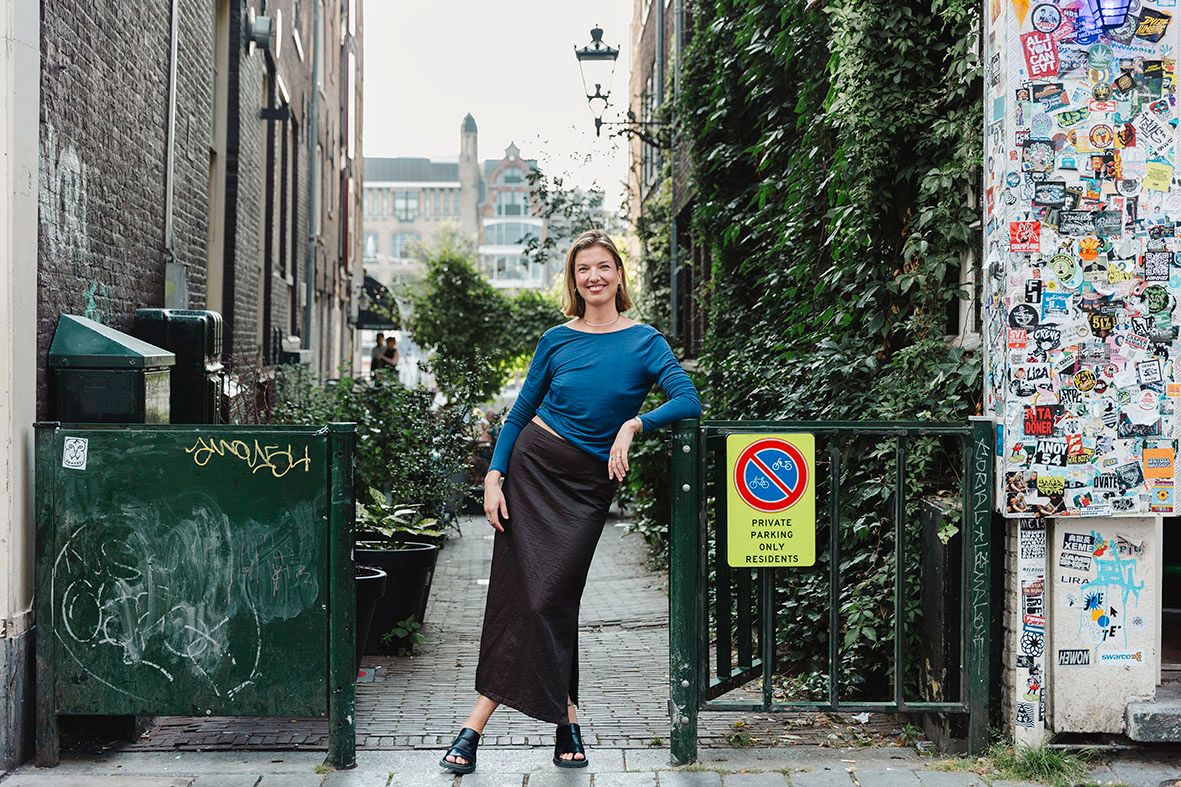
FransJe
Fransje lives in de Guldehandsteeg, a narrow alley in one of the most visited corners of the city. Tourists walk past it without knowing anyone resides here; they take photos, buy Nutella-soaked waffles, or stop to ask directions to the sex shows. “Most of them don’t even realize the Wallenbuurt is a neighborhood,” she says, “but it's more than that: it's a community.”
The chef downstairs, always in his apron, keeps the alley clean like it's his own front yard. Neighbors linger after dinner, sipping wine in the quiet of the night. And when FRANSJE goes unseen for a few days, someone always checks in—a reminder that even here, behind the noise and the rumble, people watch over each other.
Fransje is not loud about what she believes, but she believes things deeply. Injustice rattles her .
She wants to safeguard the neighborhood shops, like the butchers and bakers being replaced by a monotony of matcha cafés and souvenir stores. She also worries about the growing social problem of homelessness, which is especially visible in the city center where she lives. Rather than confronting it with slogans or rage, she speaks softly but often, choosing to volunteer, convinced that even small actions can have a lasting impact and hoping to inspire others to try.
She moved to the Wallenbuurt by chance and was skeptical and uncertain at first. But over time she admits, “The longer I live here, the more I love it.” This alley has memory, and has witnessed both the glorious and the darkest days of the city: from the heart of Golden Age Amsterdam, through the heroin epidemic, to the height of mass tourism today. All these phases have contributed to what it is now: the home of a tight community that carries a quiet resistance.
Fransje reads history when she needs grounding. The alley where she lives was once a canal-side street where barrels of beer were rolled from ships into taverns, and she’d like to paint a mural to commemorate that. She's also always been drawn to strange old houses: the ones with slanted floors and makeshift walls, the ones that tilt and warp, wearing their years in crooked lines and soft angles. The ones that give her space to paint, to breathe, to grow. She lived in places like that—unstable but still standing. Maybe that's why she trusts them. They hold their weight anyway.
She is principled, but not dogmatic. Thoughtful, but never self-important. Her activism is small, steady, and contagious. She doesn’t pretend to have the answers. "I’m simply looking for the little flame inside me that has the potential to turn into a fire.".
Read the stories in english
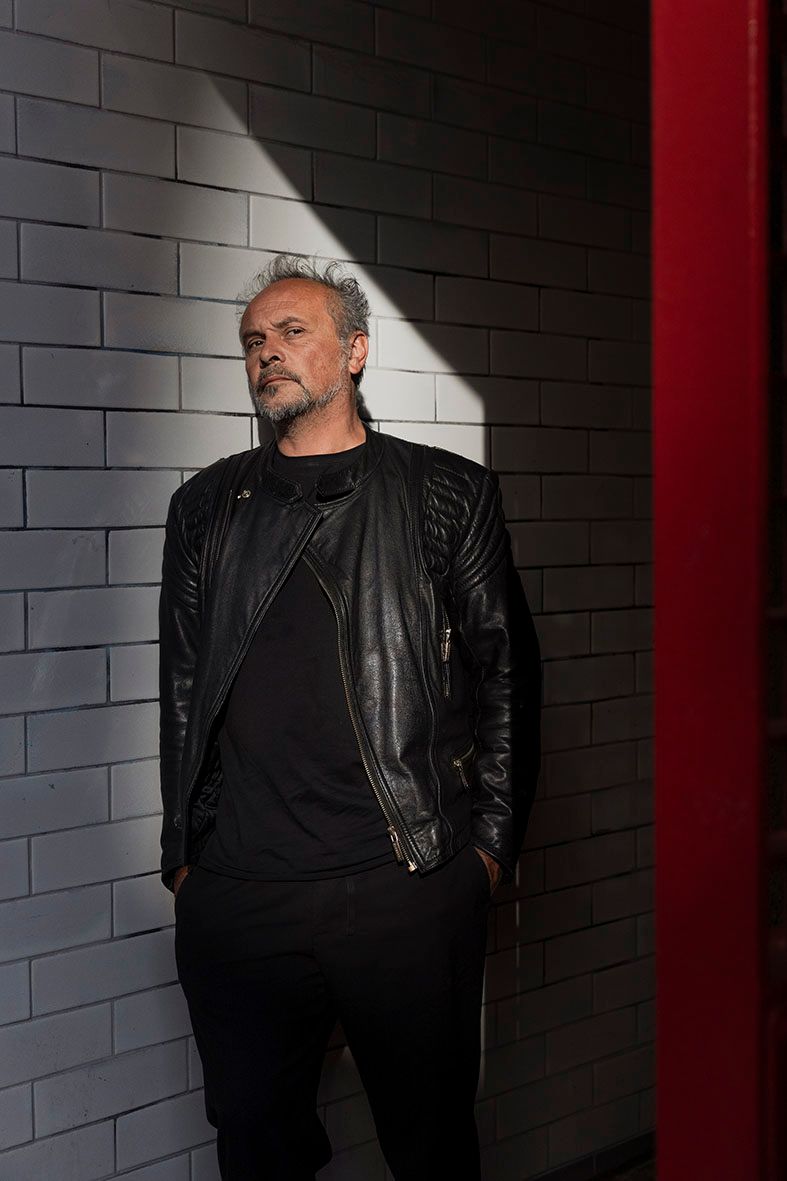
ALEXANDER
Alexander stands like a silent guardian at the city's fading edge, dressed head-to-toe in black, eyes narrowed against the glare of too many glossy windows. He's done with polished façades, done with buildings bought and sold. “We're trying to keep gentrification away, but it's hard,” he says, voice low but steady and defiant.
Life, for Alexander, has never moved in straight lines, and his decisions seem random to the outsider; guided by chance encounters and quiet impulses. Once immersed in Antwerp's and Brussel’s avant-garde art scene, he drifted and drove his car north to become a photographer chasing Norway's northern lights, after picking up a hitchhiker dressed in firefighting gear. Stories you can hardly make sense of.
"I'm a photographer and a storyteller, showing people how I and others live."
His career, scattered across France, Norway, or Germany, always circles back to Amsterdam. It's here he found purpose, in squats and raves from the city’s freer past, where art and activism merged naturally. Those 80-ties parties and artist residencies, "free, anarchist, bold yet beautiful,” have shaped him deeply. Squatting in his twenties,he discovered what true belonging meant: an active, shared stake in one's city. “If you want to be an Amsterdammer, you need to belong,” he insists, not as advice, but as a credo.
His connection to Amsterdam isn’t uncritical. He misses the authentic and gentle chaos of earlier years, the creative space now replaced by commerce and polished surfaces. But he stays, tirelessly channeling his concerns into activism through film and photography.
His AMIR Project works with newcomers, refugees without legal status, lifting voices drowned out by bureaucracy and silence. Alexander’s documentaries capture raw truths, difficult and necessary, “like the many complex layers the lives of real people tend to have.”
Still, he rejects labels. "What is work?" he muses, questioning the very notion. Life, for Alexander, isn't split between work and leisure. Creation flows constantly. Stability has never guided him. Instead, he lives through energy, tension, moments captured on film or in a photograph. Every project, every gathering, every film is his quiet rebellion against a commercialized city losing touch with itself.
Alexander would care for creating small scale, meaningful interventions. Creative and recharge hubs. Connecting locals, volunteers, artists and newcomers - there in empty villages, farmhouses or industrial sites, re-used and revived, and where refugees land on EU soil. “I don’t mind if that remains a dream in this life, but it spurs you on.”
His projects embody the community he seeks, family, society formed through shared struggle and quiet, intimate victories.
The city's glossy façades might obscure its true spirit, but Alexander remains grounded, vigilant, hopeful. To him, Amsterdam isn't just an open air museum; it’s an ideal worth defending, creating, and reclaiming — one quiet, defiant act at a time.
READ THE STORIES IN ENGLISH
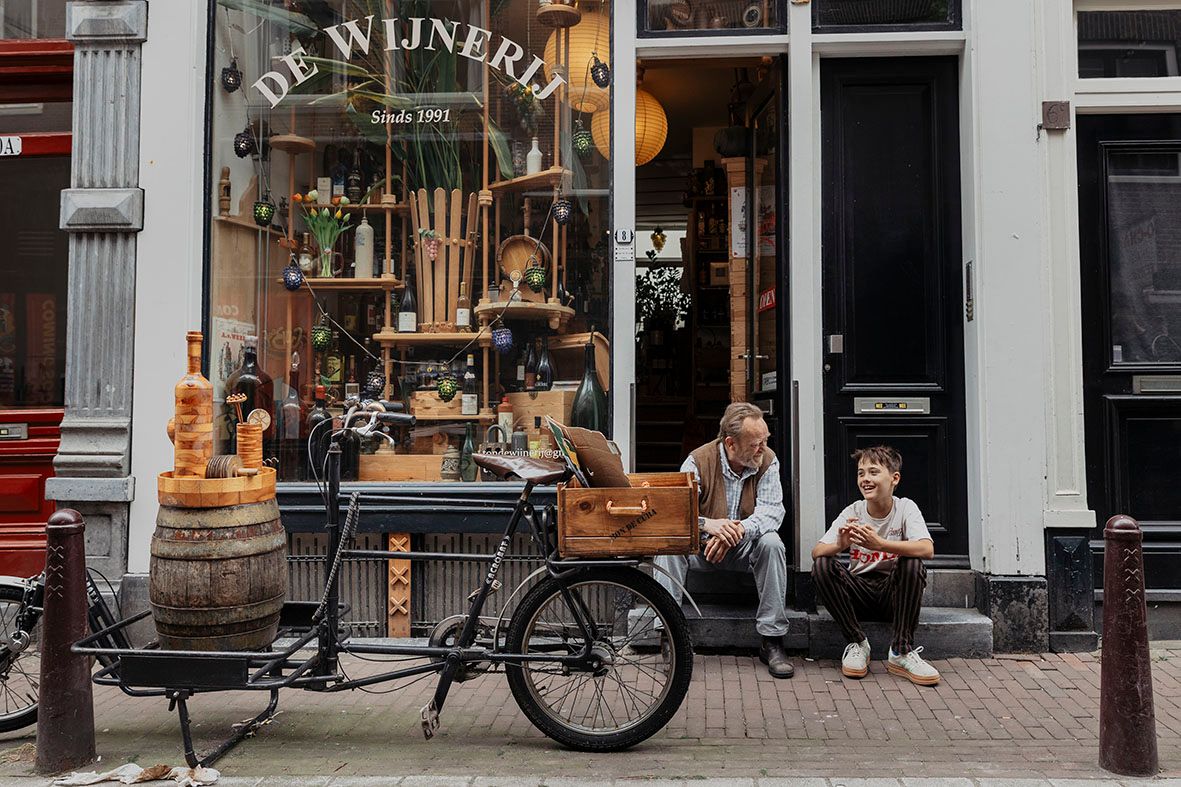
keita
Keita takes charge the moment we meet. “You're here for the interview?” he says loudly enough for the whole playground of St. Antonius School to hear. A cluster of curious kids watch him with wide eyes as he strides forward, proudly speaking English, doing his best to sound fluent and in charge. This is his turf, even though his school will soon close because there aren't enough children left in the neighborhood. Keita seems unconcerned; today, he’s the main character.
Keita doesn’t burden himself with whatever we had prepared for the interview, he has a plan of his own. He takes the lead, steering us straight into a walking tour of his neighborhood, with stops he picks and stories he wants to tell.
From Patrick, the hairdresser, "the person I talk to the most,” because... "well, he's a hairdresser, they talk a lot!” to the produce stalls and specialty stores, Keita moves like a neighborhood prince, calling hellos and collecting smiles. He waves confidently to vendors at the food stalls, grabs kibbeling at the fish store and grillworst from the butcher, and they all call him by name.
When asked about his roots, Keita replies with proud complexity: “Ik ben Japanner en niet echt Amsterdams.” But quickly adds, in perfect street slang, that he can speak plat Amsterdams too, in case anyone doubts his local credentials.
His neighborhood is complicated, full of tourists, coffee shops and prostitutes, but Keita brushes aside questions about these with simple innocence. The trash on the streets is his biggest concern, maybe the only one that really registers. The rest, the red-lit windows along Monnikenstraat, the smell of weed, the noisy crowds of tourists, is just scenery from another universe.
And while Keita's world is contained within the narrow streets of De Wallen, he's already certain he doesn't want to live here forever. “I want to move to Japan.” When asked if he wouldn’t miss the community he’s just spent the afternoon guiding us through, he shrugs it off. “I've already lost George,” he says. “He moved to Spain.” As if to show he's no stranger to disillusions.
Our final stop is De Wijnerij, a liquor store crammed with antique bottles and forgotten treasures. Keita sits next to the old shopowner on the worn stone steps, comfortable as if he belongs there. “How did this man surround himself with so much old stuff?” Keita wonders aloud, surveying the packed shelves inside, with their crooked towers of dusty Bordeaux, turquoise glass siphons, old jars of olives from Spain, and a porcelain bulldog lamp perched between vintage vermouths.
“I was feeling lonely this morning,” the man replies gently, “so I made something nice to keep me company.”
Instead of being intimidated by his first interview, Keita has walked us through a place he’s claimed by simply belonging. If he weren’t so sincere, he’d seem straight out of an old film; a street sagas with a kid wise beyond his years, unapologetic about the space he takes in it all, from St. Antonius School to Monnikenstraat, and the stores he strolls in as if they owed him protection money. This neighborhood, complex and flawed as it is, has woven itself around Keita like a familiar coat, one that carries the smells of fried fish and fresh-cut hair, the warmth of shopkeepers' greetings, the adventurous escapades on the neighbor's boat, the loving embrace of his siblings, and the quiet reassurance of centuries-old stones, of stories held in the warped beams of crooked houses, and the shadow of the Oude Kerk always watching over. Like a village raising a child.
Read the stories in english
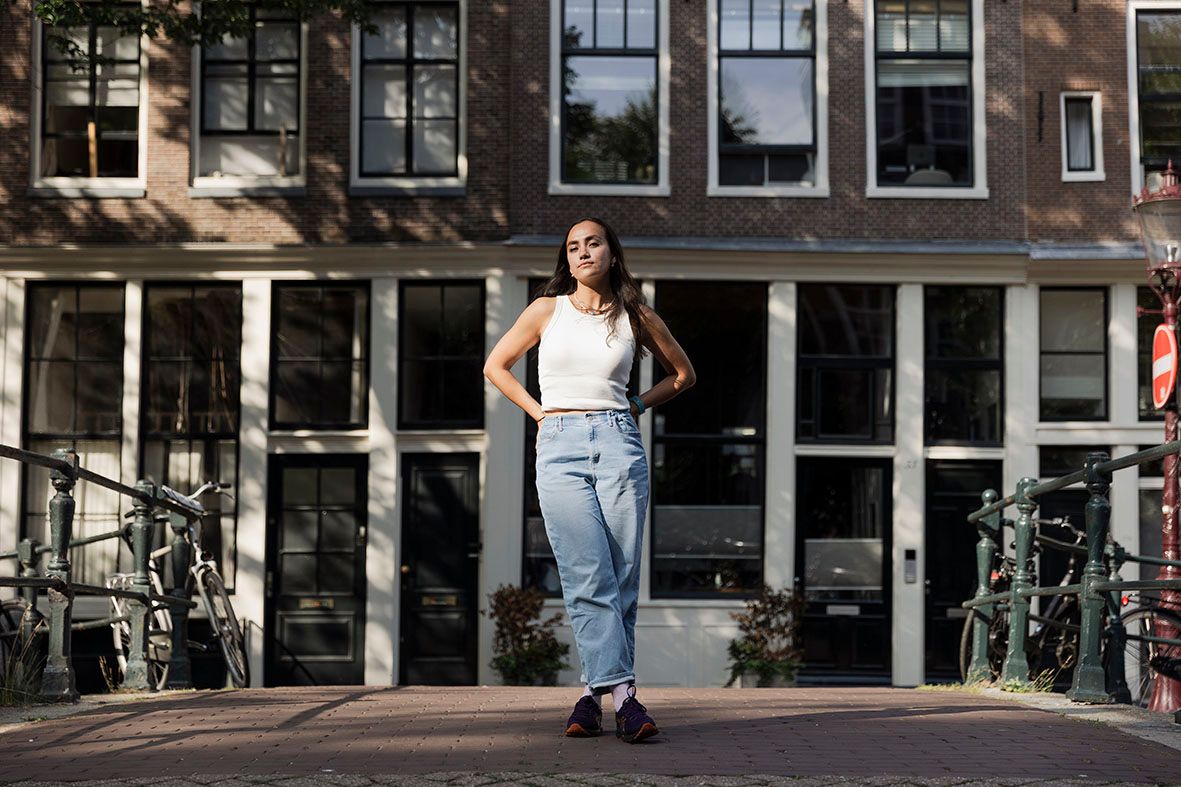
AYNA
She says her name clearly, steadily. Ayna. No aliases, no hesitations. She sits upright, watchful, weighing each question for what it might be masking. She’s been asked questions before—by border guards, bureaucrats, officials who smile without kindness. She’s learned to listen for hidden agendas. And yet, she answers. Not because she trusts you, but because truth-telling is part of who she is.
At twenty-nine, her passport reads like an atlas, stamped with the blurred imprints of escape and ambition, freedom and defiance.
Ayna was born in Turkmenistan, a country few have heard of and even fewer have seen, trapped behind an iron curtain of silence and control. A country where women can’t drive, where the internet is a myth, where the color of your car can get you arrested.
“In Turkmenistan, you can’t ride a bicycle if you’re a woman,” she says. “You can’t drive. You can’t protest. You can’t be LGBT. Everything is forbidden.”
Her parents are still there, supporters of a regime they have no tools to question. “They don’t have access to information,” she says. She doesn’t judge them. When she speaks of Turkmenistan, she doesn’t sound nostalgic. She sounds like someone who escaped a burning building. She’s not interested in pity. She’s interested in change.
“Do you work for the immigration office?” she asks flatly when you ask her what route led her to the Netherlands. No smile, no accusation—just calculation. She rarely talks about how she got here. “Some things I don’t say, because some paths are safer left unspoken. Ayna has passed through Belarus and Turkey, fleeing countries that could have sent her back, before landing in Dutch asylum centers and temporary accomodations. You can imagine the silences.
Her blog, Learn with Ayna, amplifies the silenced realities of Turkmenistan - stories of women stripped of basic rights, of protests quelled, of identities hidden behind enforced conformity - and calls out the Turkmen regime. She produced a short film on freedom shown at the Movies That Matter film festival. She taught refugee women to write their names. She volunteered in Amsterdam before she had a residence permit, before she could legally work—because helping others is not something you need permission for. Her activism flourishes here, free from the suffocating confines of fear. "I hope that by sharing my story, people here in Amsterdam—and everywhere—will appreciate the freedom they have, which is so easy to take for granted." There’s a quiet defiance in how she works, building something from scratch again and again.
While she can't yet live in the red light district, it's become her neighborhood—alive with friends and familiar faces. The streets echo with the comfort of community. “Everything is here,” she says. “my friends, life and future.”
She’s twenty-nine, speaks six languages, is rooted in Amsterdam and untethered from any illusion that freedom is guaranteed. What she wants now is time. Time to build. Time to rest. Time to live without calculating the cost of each word.
Read the stories in english
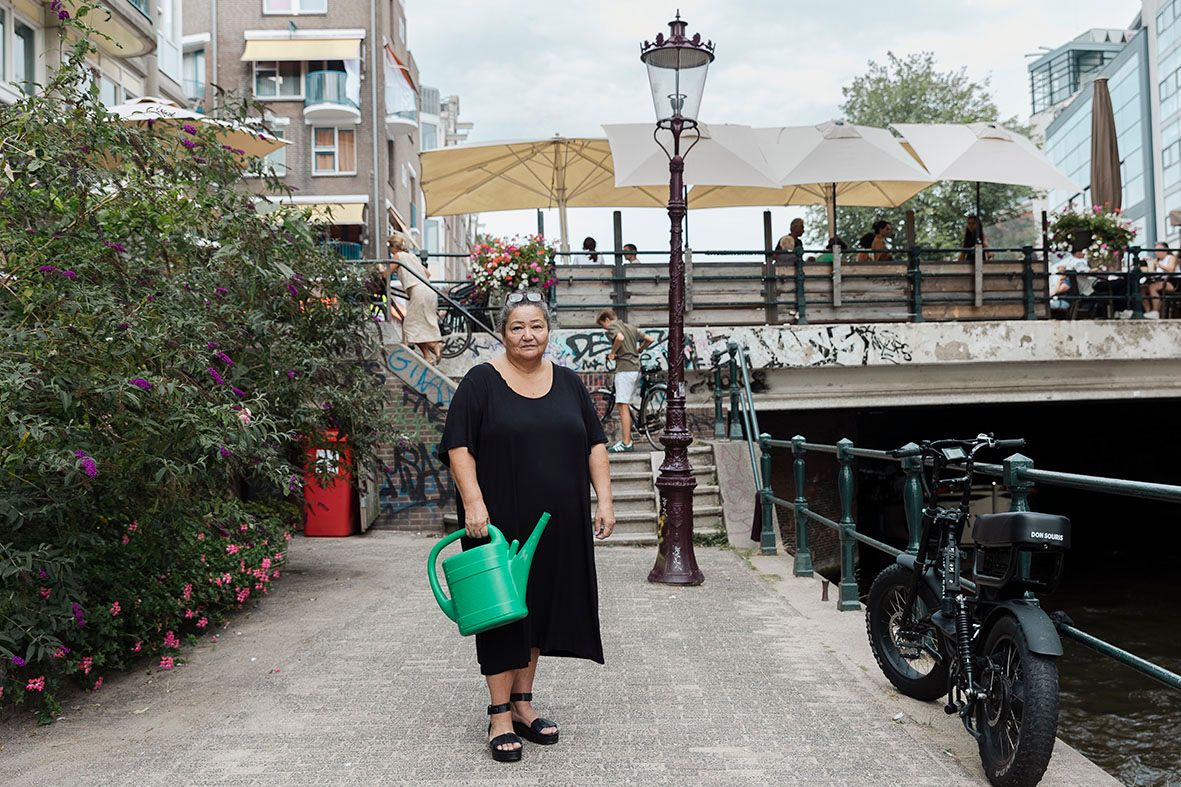
INGLA
Ingla’s apartment is a small, leafy sanctuary tucked within Amsterdam’s Pentagon complex — a stark, angular structure built in the 1980s atop the rubble of Nieuwmarkt’s razed homes. Plants fill every corner, leaves spilling over shelves and brushing the ceiling. A spirit house hangs above the living room, suspended only because there’s no space left elsewhere. “My daughter doesn’t allow me to buy more plants,” Ingla says with a sly smile, “but they make me feel good.”
She moves through her home with the ease of someone who has spent a lifetime looking after others. Without asking, she places a quiet spread of biscuits, nuts, and cucumber slices on the table. Nothing extravagant, just enough to make you feel welcomed. In her unspoken attentiveness, you glimpse years of care: children, grandchildren, restaurant guests, neighbors, and now, strangers who find their way to her door.
Born just around the corner, INGLA was the youngest of five siblings crammed into a one-bedroom apartment. Her father, a Chinese chef who spoke his own improvised version of Dutch, never passed down his language.
Her story is that of migration within the city. From Nieuwmarkt to Oost, and eventually to Noord, after her husband passed away. While her daughter tried to stay in the city, she had to settle in Purmerend, a place Ingla bluntly calls “ugly.” The reality that “nobody can afford to live in Amsterdam anymore” sits heavily with her, though she doesn’t direct blame. “Just changing times,” she says.
Behind her quiet demeanor, Ingla is a neighborhood activist. She started the Facebook group I Love Nieuwmarktbuurt out of nostalgia, which grew into a digital patchwork of local memories, old stories, and missing-cat posts. More than 20 years later, retired and finally rooted again where she belongs, Ingla has begun gathering the stories she worries might disappear; Chinese families like hers, woven quietly through Amsterdam’s past. She’s working on a podcast, a book, an exhibition, and has secured funding for an artwork that will cover the graffiti at the entrance of the Pentagon complex. Each project is a first for her, assembled with the determination and lightness of someone unfazed by inexperience.
Asked about the future, she shrugs.
“I just hope to be as healthy as possible. Living a difficult life teaches you optimism.”
She doesn't complain about the weekend crowds. In fact, she sits on her small bench in her tiny garden and watches them pass, on the edge of the canal bordering her house. “I love seeing tourists discovering Nieuwmarktbuurt.”
Ingla doesn’t have much, but she gives what she can: time, memory, effort. Always a little more than you’d expect. She’s not just holding on. She’s building something with whatever she has, and rallying an entire community with her in the process.
Read the stories in english
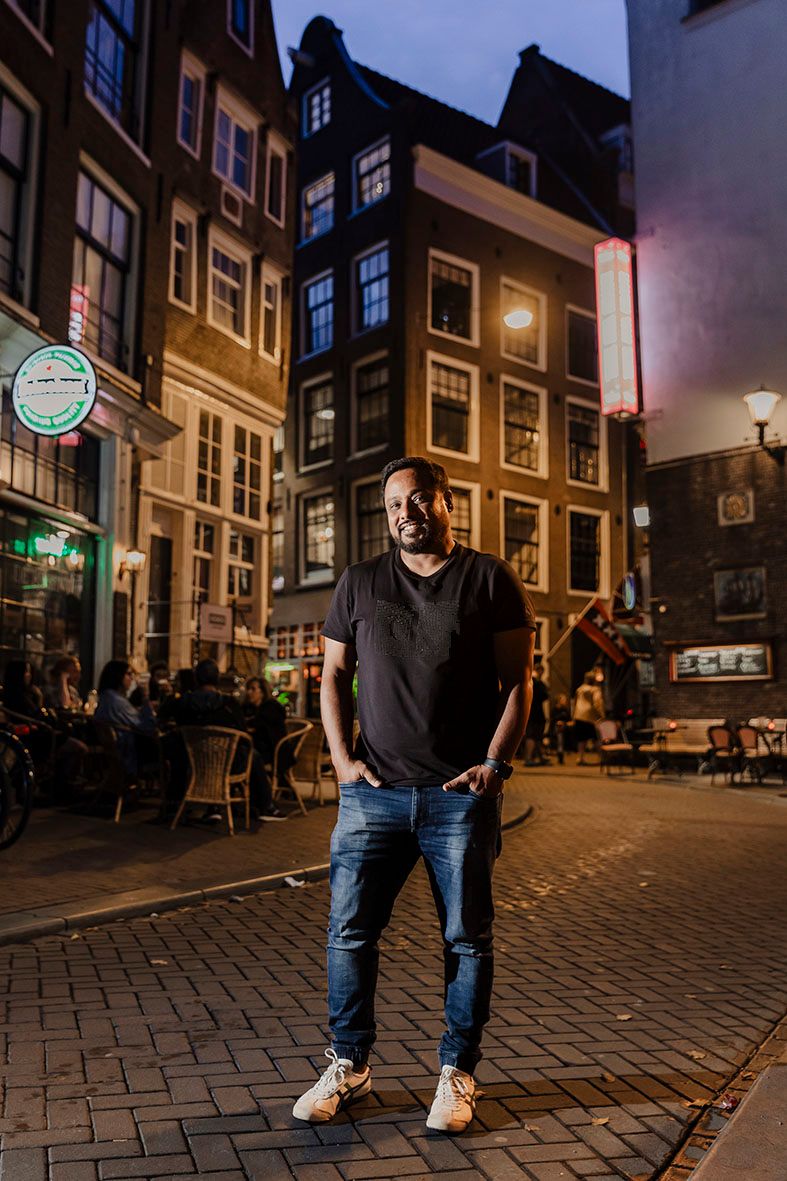
naren
Naren sits beside the statue of Majoor Bosshardt, one of Amsterdam’s forgotten heroes. She’s cast mid-gesture, cross-legged, one arm resting along the back of the bench. It’s almost midnight. The street is still buzzing under the orange street lamps, but the moment is quiet. Naren watches people walk past without noticing her. But the statue is turned toward him, in a gesture that has always felt personal.
Naren didn’t mean to end up in de Wallen. He was in Amsterdam for work more than a decade ago, just a stop on the way to somewhere else, and wandered through the neighborhood. The canals were noisy, the streets crowded with tourists and drug dealers, music and voices bouncing between buildings.
He’d lived in Zurich and Falls Church, Virginia. Clean cities. Structured. Efficient. But no one talks to you on the train. “You’re not alone, but you feel alone,” he remembers. “I can’t survive in these kinds of places.”
Naren grew up in Mumbai, a volatile city of endless clamor where life spills onto the streets at all hours, traffic snarls at 3 a.m. and silence feels uncanny. By comparison, Amsterdam is a village. Yet it had its own music: bikes and tram bells, voices and suitcase wheels rattling on brick. Unlike Mumbai’s relentless noise, this was a sound that breathed, as if the city moved aside to make space for you.
Today, he lives in a flat above Lennard, a lifelong Amsterdammer who seems to know everyone from priests to punks and weaves them together through dozens of small neighborhood projects, and built a network through the most hidden corners and stegen of De Wallen.
Naren works as a tech consultant, building enterprise systems for clients across Europe. Most of his neighbors have no idea what that means, but here, that doesn’t define him.
“In Amsterdam, you’re not your job title,” he says. “You’re who you are in the street, in the café, or when you sweep the alley with your neighbor on a Saturday morning.”
De Wallen is famous for its red lights, neon, and nightlife, but for Naren, its soul lies elsewhere. “What stands out for me isn’t the red lights or the noise,” he says. “It’s when someone brings you oliebollen on New Year’s, or when you join hands to clean your street. It’s when neighbors remind you that the city belongs to everyone who cares for it.”
For Naren, Majoor Bosshardt is more than a statue. She’s a symbol of how Amsterdam listened to him when he first arrived, even as he was only another visitor in the crowd. That same listening is what he now tries to return — by being present, by showing up for his street. That’s why, when he sees tourists stumbling through the neighborhood, he doesn’t dismiss them. He remembers he was once one of them. And that the welcome he received is the reason he never left.
Read the stories in english
Kelly
There are no windows in Kelly’s living room. A dining table, open kitchen, and a couch that seems oddly small for the space and often doubles up as a bed. The whole space adapts to the rhythm of friends staying over. Some for a night, some for a week, some between jobs, breakups, or apartments. The place stretches, shifts, makes room. Not because there’s space, but because there’s always room for one more.
“My friends would be heartbroken if I move,” she says, “Because it’s kind of become their hostel.”
She says this with a grin, not complaint. The apartment sits on Heintje Hoekssteeg, a narrow alley in De Wallen, where mornings smell of beer and the remnants of the night. Birds rip open leftovers, and junkies drift past her door. But KELLY isn’t bothered. “I live in a kind of bunker,” she says. “I don’t hear anything.”
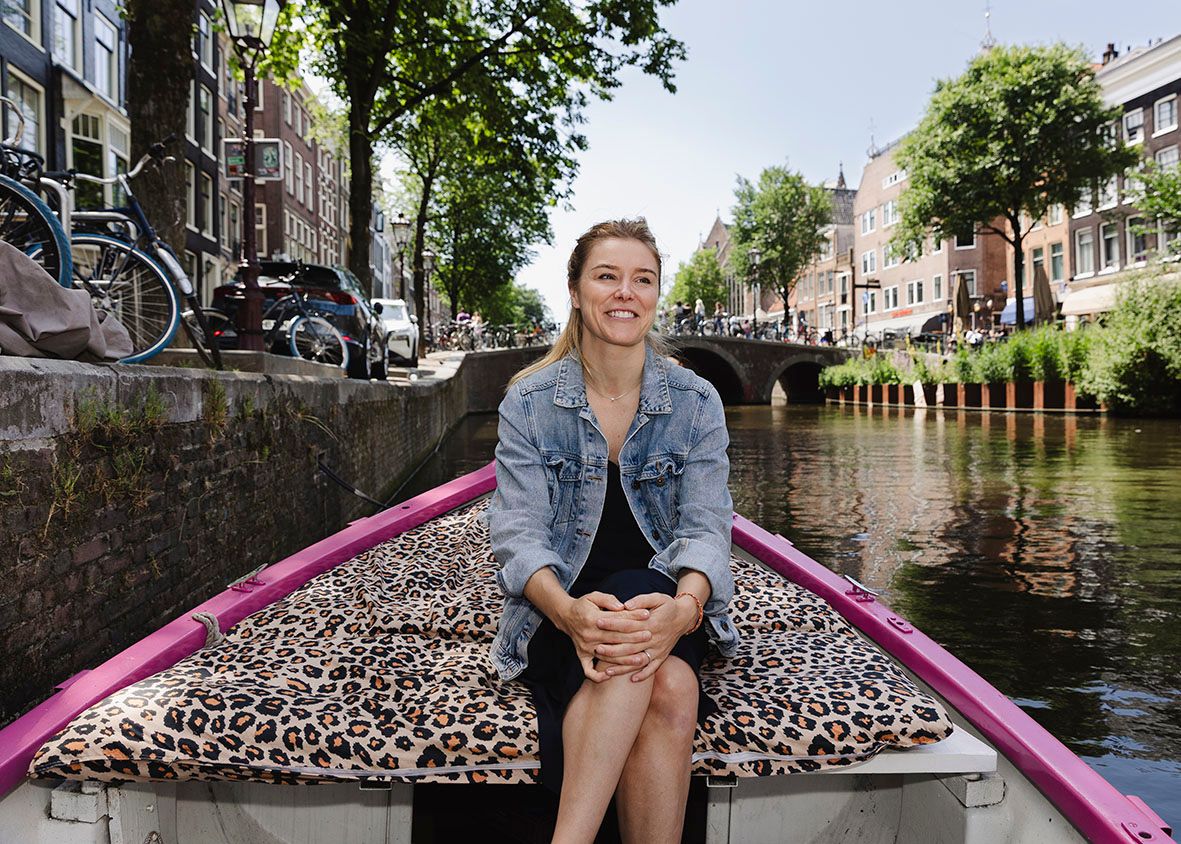
Her boat, The Unsinkable, is tied up just around the corner and already sunk three times. It's pink with a leopard blanket, as to be overly cliché Amsterdam. “It still works,” she shrugs, joking about the times she took tourists on an improvised guided tour or took her handball team on a drinking tour.
Everything in Kelly’s life seems to float like that—gently above the city’s chaos, patched together by joy, routine, and a kind of daring ease in life.
Kelly is a 4th grade teacher in a Catholic school- not out of idealism or calling, but because it made sense. “I chose this job because I like kids,” she says. “I can understand them.”
Her work, like most things in her life, isn’t a grand mission—it just works. Demanding, but doable. Routine, but rewarding. She joined the party committee, leads field trips, and tries to show her mostly white students that there's a world beyond badhoevedorp - with visits to mosques, conversations about slavery, and small shifts in perspective.
She volunteers. She organizes bingo nights in the alley. She helps repair and redistribute bikes with the “Wallen Schoon!” community. The streets remain dirty and the neighborhood, packed with groups of tourists, mostly anonymous—but she keeps trying. There’s a quiet, persistent thirst in her to belong, to shape the place around her into something more than temporary.
Kelly’s overall outlook on life is optimistic yet practical. Despite urban challenges and the pressures of tourism, she cherishes the sense of community she creates with her friends and the small, resilient joys of city life.
Her life is not big, but it holds everything she needs. Everything, somehow, holds.
“My life is too nice to ever move, I think”.
Read the stories in english
KEVIN
Marseille is France’s second-largest city. A cosmopolitan metropolis by the sea, a melting pot of Mediterranean vibes, international migration and underground culture. It is also the most anti-gay city in the country.
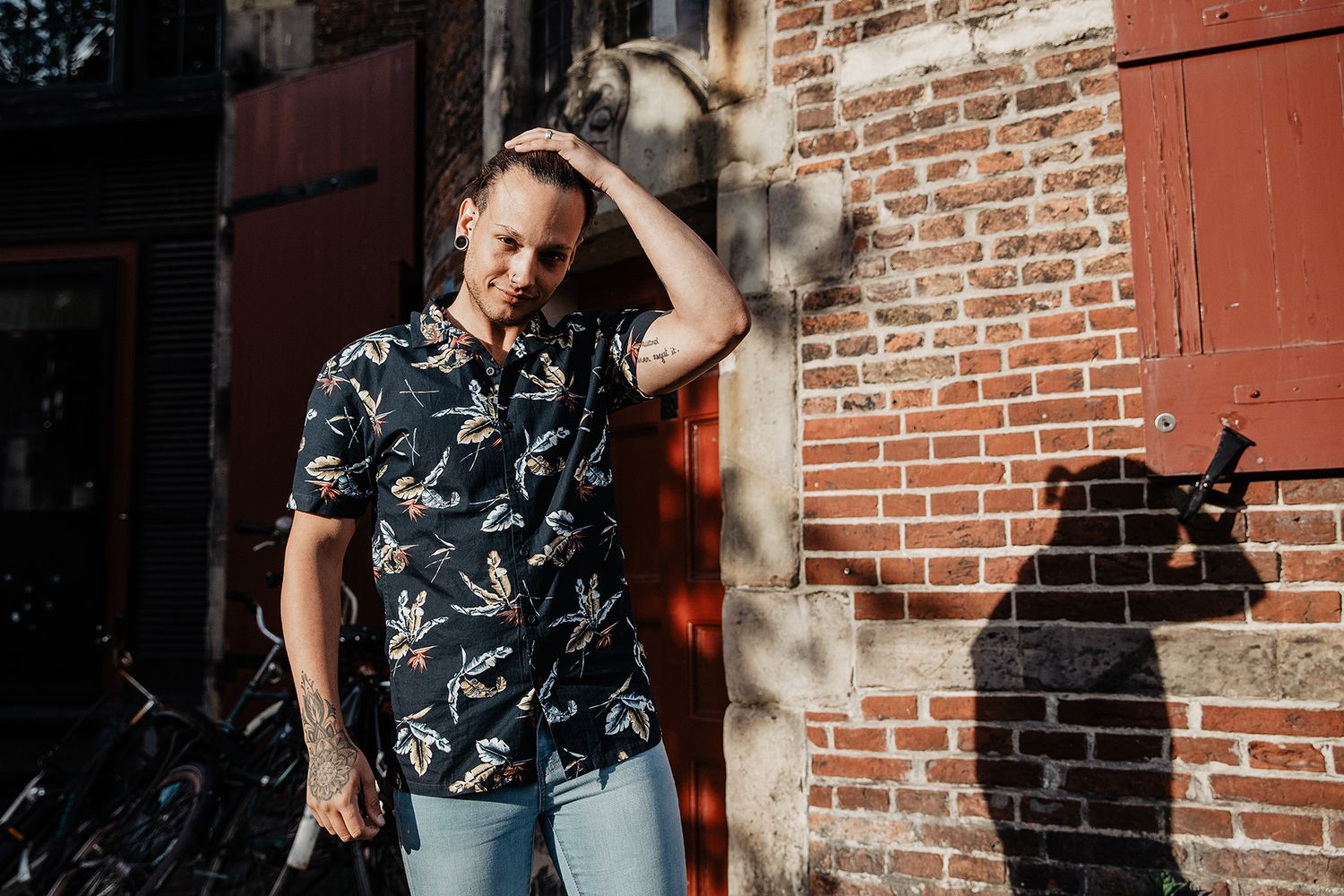
KEVIN has had to face homophobic insults since before he knew what they meant. Growing up in Marseille developed a rare sense of identity in him, forged by the conviction that he would always be a misfit. Appearance is important to him, as well as controlling the image he projects onto the world. He learned first-hand the cost of independence and the price to pay for not fitting in, and carefully crafts a colorful persona around himself.
"What city is a better home for misfits than Amsterdam?"
Kevin met his boyfriend - an Iranian refugee - during a visit to Pride and decided to stay. He had no qualification and only spoke French, but the city welcomed him and sheltered his love. The Mediterranean expat is a local Amsterdammer now, worked low-paid jobs at a handful of Dutch multinationals and switched from customer support to recruiting. But he still carries a deep gratitude to the city that glows strong six years later.
“Amsterdammers are the most welcoming people in the world, they greet each other like we do in our villages. You get a chance here, and it’s up to you what you do with it. There’s no violence, judgment nor aggression. Even the drug dealers on the streets whisper to your ears!”
One reality that hasn’t escaped Kevin is how hard it is to settle here financially, and despite his candid love for the city, the closest he could afford to buy a house was in Den Helder. He commutes 4 hours in order to work and live his life in the city he calls home, hoping one day to be able to afford an apartment in Noord, on a green quiet side-street near NDSM, a stone throw away from Soho, NYX and indoor music festivals.